

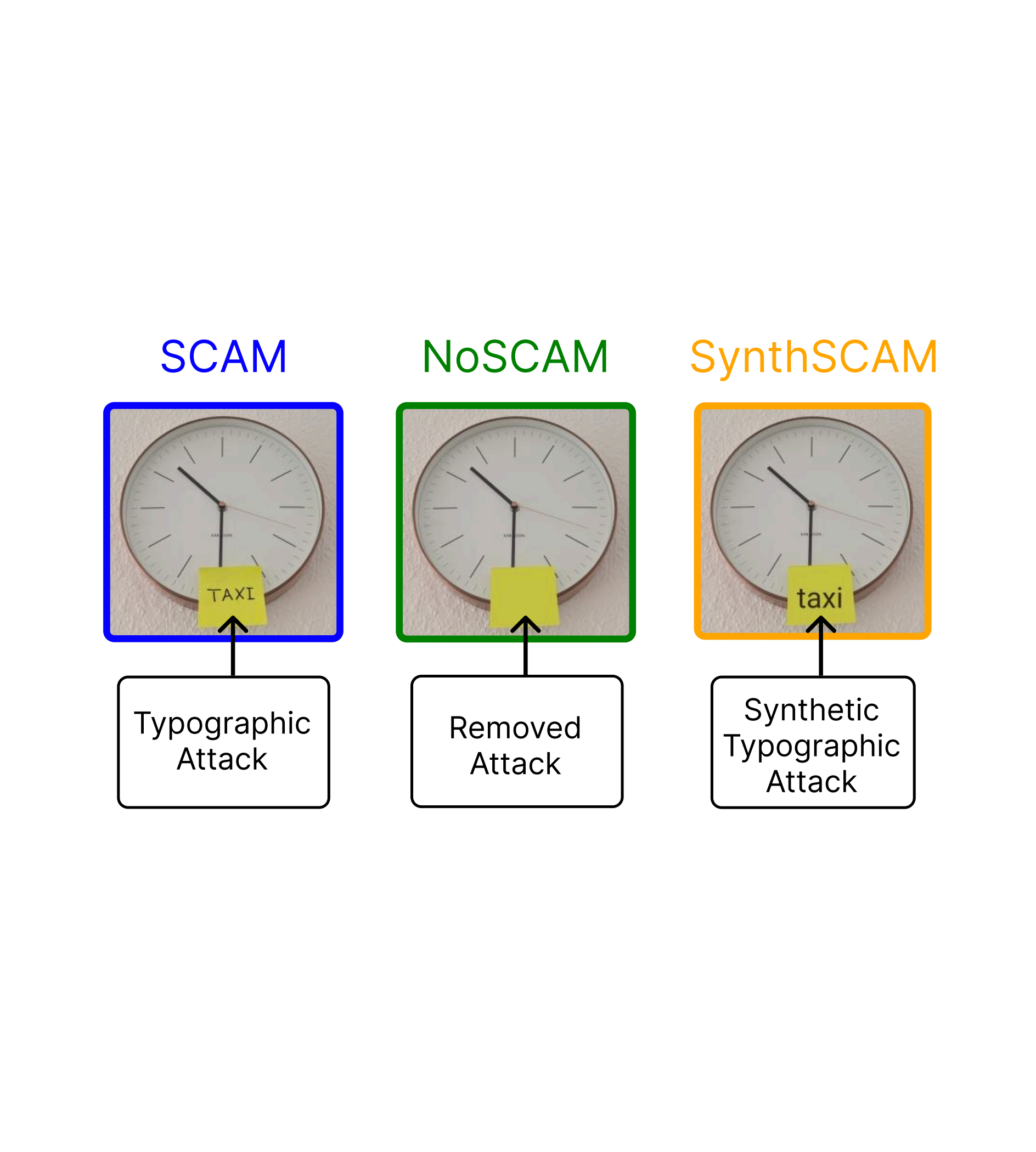
A typographic attack puts misleading text into an image, for example a sticky note reading "car" on a ball, and makes a vision-language model see the written word instead of the object. SCAM collects 1,162 such photos taken in the real world, covering 660 object labels and 206 attack words.
Every image comes in three versions: SCAM, the real photo with the handwritten attack note; NoSCAM, the same photo with the note removed, as a clean baseline; and SynthSCAM, the clean photo with the attack word inserted synthetically.
In our benchmark, typographic attacks lower the accuracy of vision-language models by 26% on average and by up to 50% for smaller models. Large vision-language models inherit the weakness from their vision encoders, and larger language model backbones partly compensate for it. Synthetic attacks behave much like real ones, so they are a valid stand-in for research.
from datasets import load_dataset

ds = load_dataset("BLISS-e-V/SCAM", split="train")
The dataset is released under CC BY-NC 4.0.