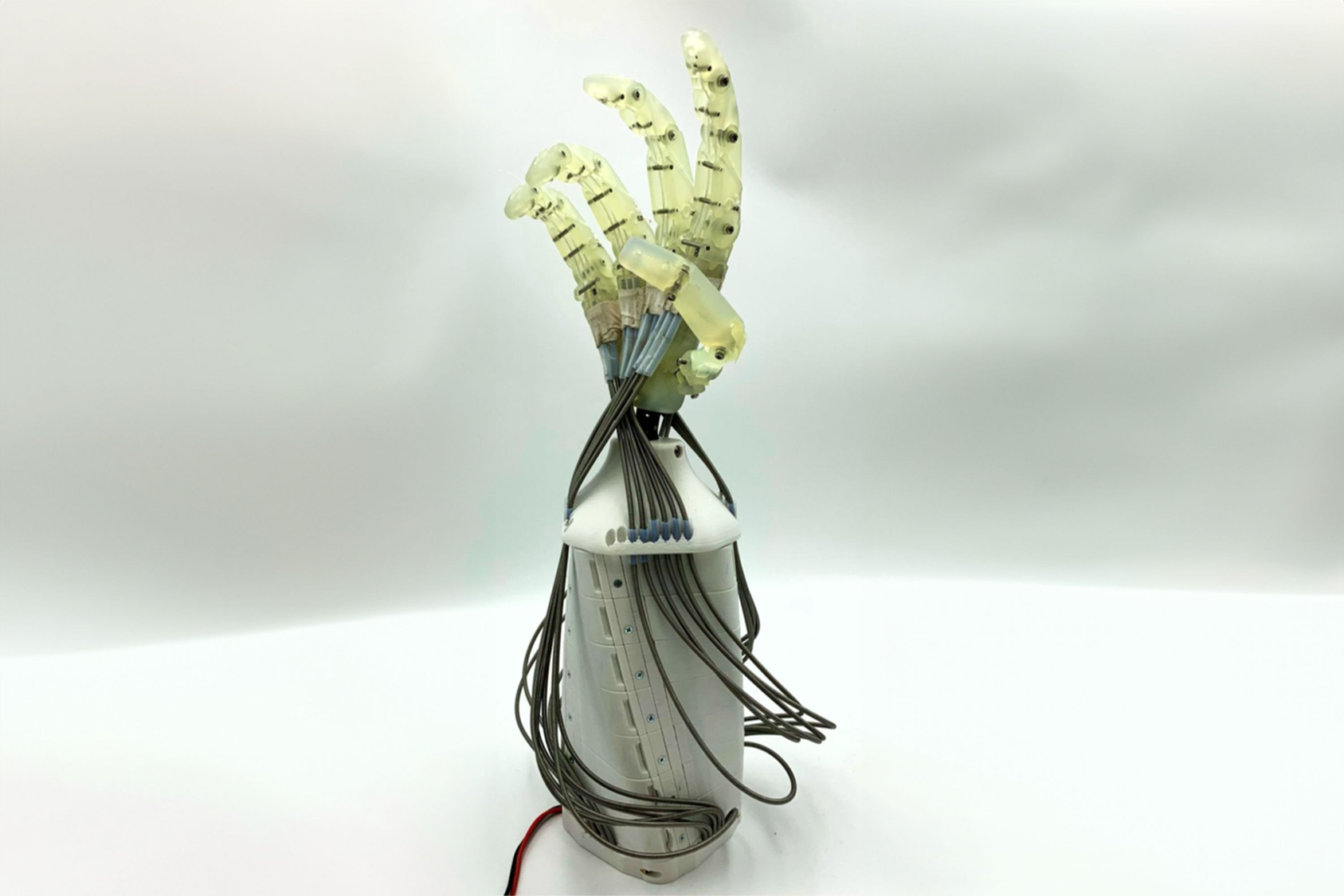


The SIRo Soft Hand is a highly dexterous anthropomorphic hand featuring inherent mechanical compliance based on antagonistic tendon-driven actuation.
Mechanical Intelligence through Soft Robotics
Soft robotic hands leverage passive deformation of their inherently compliant hardware during interaction with their environment and with humans to prevent damage and improve safety. Furthermore, deliberate exploitation of passive deformation has shown to substantially reduce demands on accuracy in sensing, modeling, and actuation. Based on these principles, compliant robots demonstrate complex yet reliable behaviors despite following simple strategies. For example, when the morphology of a soft hand passively adapts to the object, resulting in robust grasping and manipulation.
Following this premise, soft robots effectively outsource relevant aspects of low-level control from software to hardware, as the soft body implicitly realizes mechanical impedance control. In most soft hands, the level of compliance is directly coupled to posture, which can result in undesirable passive responses (for example, when soft fingers bend away from the object during grasping).
Variable Stiffness for Dexterous Manipulation
The ability to adjust compliance levels independently from posture during operation can profoundly enhance the capabilities and performance of soft systems. For example, when a soft gripper in a low stiffness mode passively conforms to the contours of a delicate object, before stiffness increases to securely constrain and grasp the object without damaging it.
The SIRo Soft Hand serves as a reliable and versatile research platform for investigating the promising benefits of variable stiffness on contact-rich interaction with the environment, dexterous in-hand manipulation and safe human-robot interaction.