


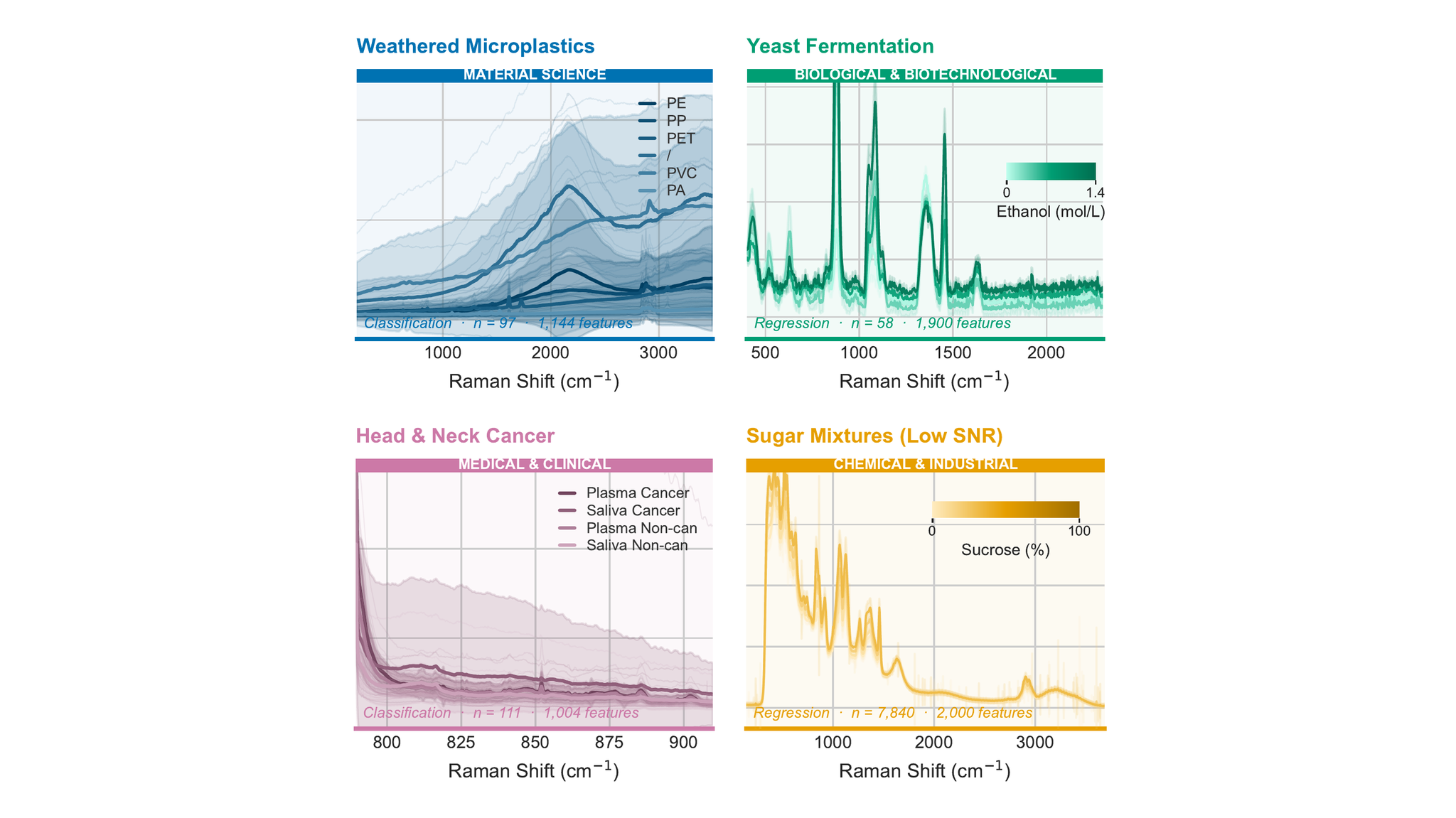
Raman spectroscopy reads the molecular fingerprint of a sample from the way it scatters laser light. It is non-invasive and remarkably versatile, used everywhere from material identification and bioprocess monitoring to medical diagnostics and chemical process analysis. Yet for most of its history, the analysis of these spectra has leaned on chemometric methods like PLS, tuned by hand, one dataset at a time. We kept returning to the same question. Could a model pretrained once, on large amounts of synthetic data, simply be pointed at a spectrum and match those carefully built pipelines?
Christoph had already gathered the first clue. In a small benchmark on eight datasets, TabPFN v2 came out as the second-best model, with no Raman-specific engineering whatsoever. If a general-purpose model could already compete with methods the field had refined over years, then a model actually trained on Raman data ought to do considerably better.
That became the idea we set out to build. By adding a second pretraining step on real spectroscopic data, we wanted to turn a general tabular foundation model into one that understands the structure of Raman signals from the start. We call it RamanPFN.
The problem was evaluation. To show that such a model is genuinely better, you have to measure it broadly and against strong competition. And here we hit a wall: Raman spectroscopy had no benchmark on anything like the scale that vision, language, or tabular machine learning take for granted. Public datasets were scattered across platforms like Kaggle, Hugging Face, and Zenodo, stored in a dozen incompatible formats, often behind restricted or unreliable access, and rarely curated for reproducible analysis.
The data itself did not fit the existing benchmarks either. Raman spectra live in a high-dimensional, low-sample regime, with strongly correlated peak intensities sitting on a shifting non-linear baseline. That is a different world from the heterogeneous tables of TabArena or the single-sensor series of the UCR and UEA collections. In short, there was no reliable way to ask whether one model was actually an improvement over another.
So we built that way. We collected public Raman datasets and streamlined access to all of them through a Python package called raman-data, which exposes a single unified API. Instead of hunting through supplementary files and reformatting spreadsheets, anyone can now load dozens of standardized datasets in one line of code.
As the collection grew, we realized it had become much more than the Raman state of the art in benchmarking. We had assembled a unified suite of 74 public datasets, 17 of them released for the first time with this work. Together they hold more than 325,000 spectra and define 163 prediction targets across four domains, spanning both classification and regression under widely varying instruments and conditions. Then we ran 28 models through it under one standardized protocol, from the longstanding domain standard PLS to gradient boosting, deep learning, Raman-specific architectures, time-series classifiers, and modern tabular foundation models.
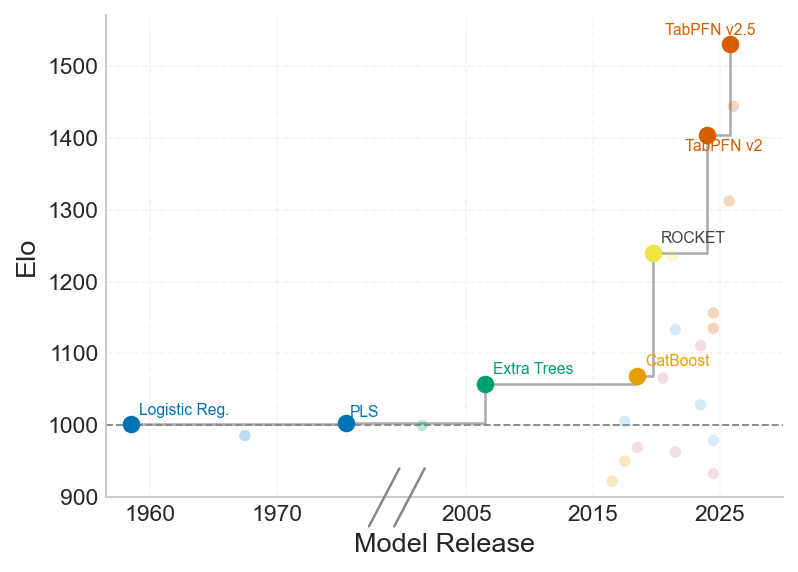
The picture that emerged was the first broad, reproducible view of where machine learning for Raman spectroscopy really stands. Tabular foundation models consistently came out ahead of domain-specific and gradient boosting baselines, and time-series models stayed competitive. But no single method generalized across all datasets, and the room left for improvement far exceeds the near-saturation seen on general tabular benchmarks. For the first time, we could even look back across the field and trace which approach would have led at any given moment. PLS, it turned out, held its ground as the de facto standard for decades before modern methods finally began to surpass it.
This was clearly worth standing on its own, so we published it as its own paper.
The result is RamanBench.
New datasets and new models are welcome, the leaderboard evolves alongside the research, and our hope is that this shared foundation helps the whole community make faster progress in medicine, biology, chemistry, and materials science.