


Clinical outcome prediction
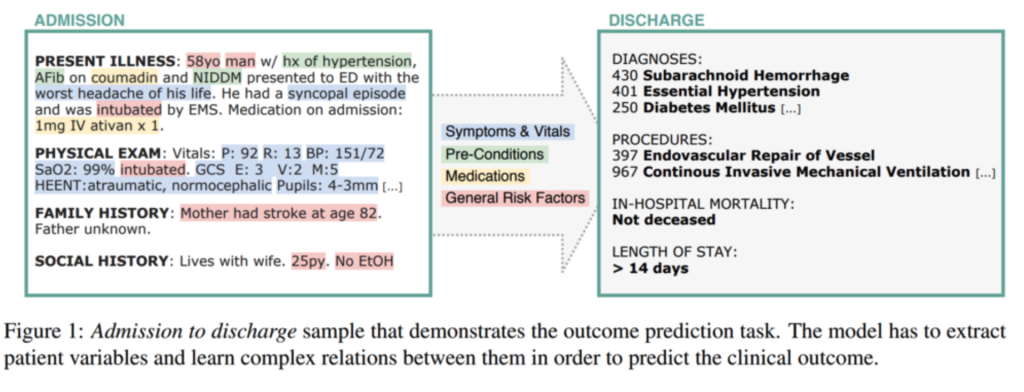
Outcome prediction from clinical text means inferring, from the admission note alone, which diagnoses a patient will be discharged with. At admission, decision support is most valuable: a system that reads symptoms, pre-conditions and risk factors in the unstructured text can act as a second pair of eyes, help doctors avoid overlooking rare conditions and help hospitals plan capacities.
The DATEXIS research group has worked on this task for several years. Within Appl-FM, the project asks how foundation models change it: are generative models better than the specialised encoders that currently define the state of the art?
Encoders: efficient and interpretable
CORe (Clinical Outcome Representations) is an encoder with a dedicated pre-training step that integrates knowledge from Wikipedia, PubMed and unlabelled clinical notes, so the model learns the relations between symptoms, risk factors and outcomes. Try the CORe demo.
ProtoPatient adds interpretability. It learns prototypical characteristics of each diagnosis and predicts from the similarity of a patient to these prototypes ("this patient looks like that patient"), highlighting the passages of the note that led to the decision.
SProto addresses the long tail: most diagnoses are rare and under-represented in the data. Sparse prototypical layers let SProto reach state-of-the-art performance while keeping the explainability of prototypical encoders. Try the SProto demo.
CliniBench: encoders versus generative models
Generative LLMs offer what encoders lack: zero-shot inference, dynamic label spaces and learning from context without retraining. Their effectiveness in realistic clinical settings had not been tested systematically, so we built CliniBench, the first benchmark that compares generative LLMs and encoder-based classifiers on discharge diagnosis prediction from MIMIC-IV admission notes. The work was presented at EACL 2026.
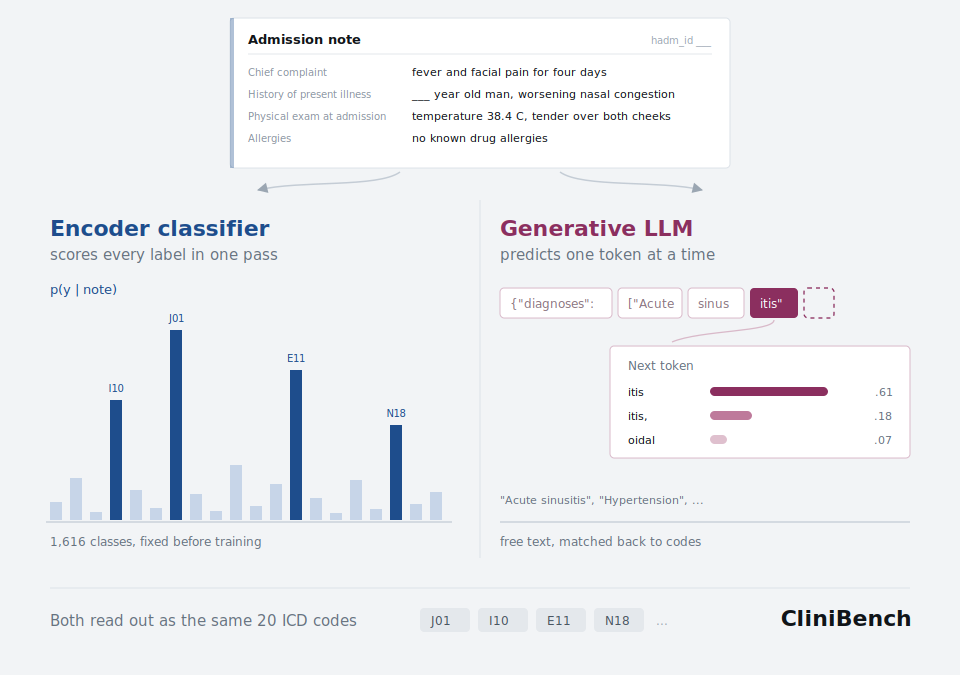
Encoder-based classifiers consistently outperform the generative models on diagnosis prediction, at a fraction of the inference cost. In-context learning narrows the gap: retrieval augmentation, which gives the LLM similar patients as examples, clearly improves its results. Generative models are therefore not yet a replacement for encoders, but they are promising where labelled training data is scarce.
Next steps
The project continues with generative models that reason about a case and check their own conclusions against medical knowledge, so that predictions come with a plausible, verifiable explanation. This work is part of the project Self-Improving Systems.